
Institute working with the country’s universities in a quest to transform Kenya into a knowledge-based economy
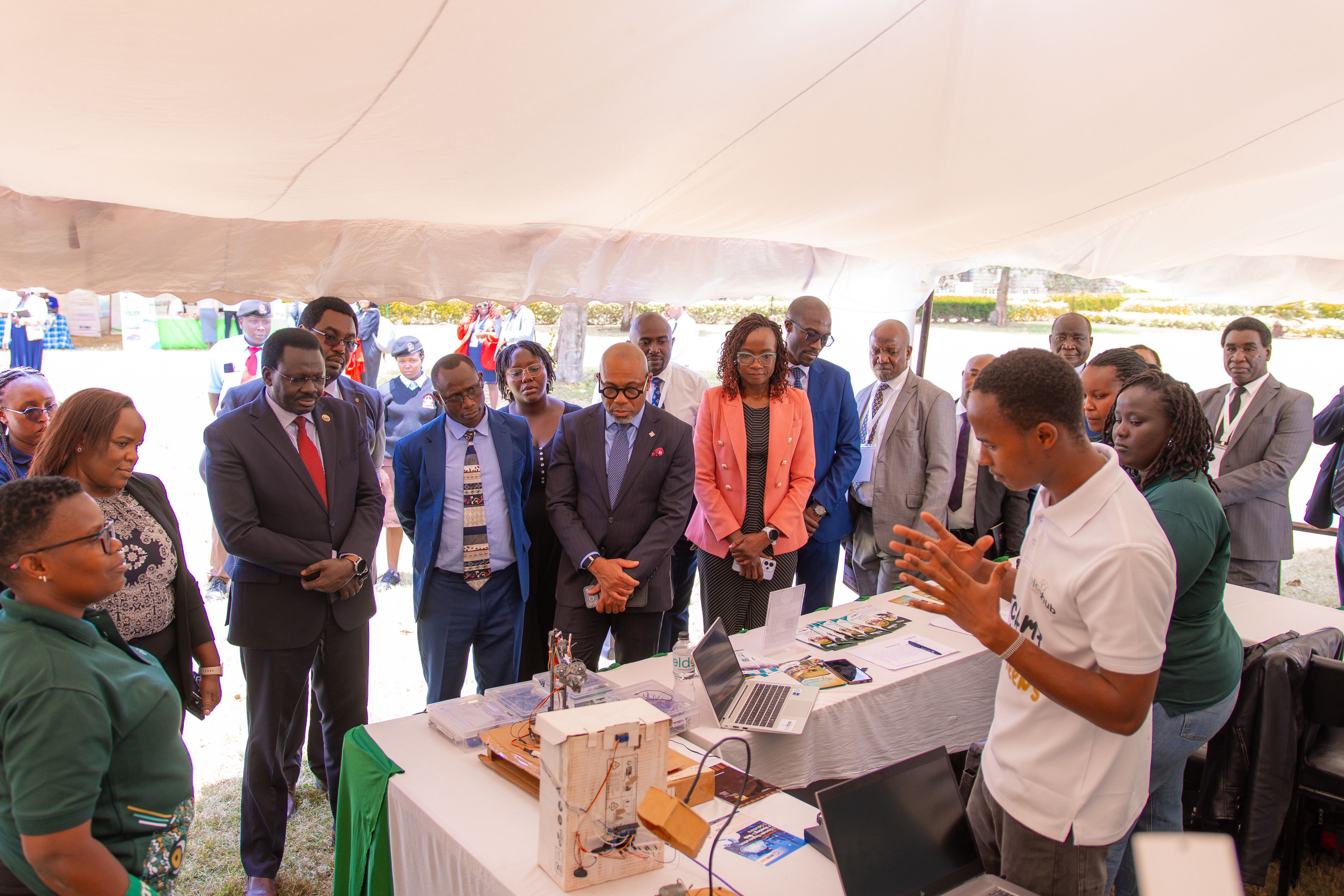
Photo: Prof. Henry Kiplangat (3rd left with a red tie), Kabarak University Vice Chancellor, Stephen Ngeno (4th Left), Deputy Managing Director, Technical Services, and Ralph Opara (5th Left), Access Bank Kenya Country Managing Director, listen to one of the innovators when they toured the exhibition stands during the Innovation Week in Kabarak, Nakuru County.
The Institute is working with universities in the country because they hold the key to Kenya's transformation from an extractive industry-based economy to a knowledge-based economy.
John Onyango, the Institute’s Managing Director, has said the universities, with their human capital in form of lecturers and students, and backed by state-of-the-art infrastructure, including equipment, will inject high-level innovation into the various sectors of the economy such as agro-processing, micro, small and medium enterprises (MSMEs).
"This will ensure these enterprises create not only quality, but also sustainable jobs. That is your role as a university," he said in a speech read on his behalf by his Deputy, Stephen Ngeno, during the opening ceremony of the Central Rift Innovation Week 2026 hosted by Kabarak University, Nakuru. "To encourage institutions including universities to protect and commercialise their IP assets, we have been assisting them to develop institutional IP Policies.", he continued.
He told participants, including the university’s faculty, students, innovators, MSMEs and representatives of State Agencies that such policies are crucial - they tell a student innovator: "If you invent here, this is how you will share royalties with the university.
"It sounds simple but such a policy would be the difference between a student sharing an invention with the university and going and developing it privately outside the university,” he said.
Onyango said universities will play their research and innovation role if the country will reap the full benefits of the proposed Geographical Indications Bill, 2026 and the National Intellectual Property Policy and Strategy, 2026.
He said once the GIs Bill, 2026 is enacted, it will protect the intellectual property of unique traditional crafts, natural products and agricultural produce whose qualities, reputation and characteristics have been influenced by their geography, including climate, water and soil.
He said: “Nakuru being a county with a large agricultural-driven economy, stands to benefit greatly from this law since products from this region like the Molo Lamb and the pyrethrum sub-sector innovations can be protected as GIs.”. The MD noted that this has the potential of turning local products into a global enterprise.
"When the origin is protected, the farmer earns more, the processor hires more, the enterprise grows as envisioned under the Government’s Bottom-Up Economic Transformation Agenda (BETA)," said Onyango. He further said the country’s higher learning and research institutions like Kabarak University will play a big role in this transformation because they will support the farmers through your research and innovation to identify the unique characteristics of these products for protection.
On the National IP Policy and Strategy, he said, once adopted and implemented, it will streamline IP management in the country, facilitate protection of GIs and trade secrets, boost commercialisation, curb counterfeits, support creatives and align Kenya globally for economic growth.
"This way, we will have a structure in place that will see any innovation that a Kabarak University student comes up with move from the research lab to the market as a product or service, hence transforming the student from a job seeker to a job creator," he said.
Prof. Henry Kiplangat, Kabarak University Vice Chancellor, said the Nakuru-based university will partner with the Institute to establish its Technology and Innovation Support Centre (TISC).
TISCs give intellectual property (IP) users such as researchers, lecturers, students and the business community around a university FREE access to over 150 million published patent documents and scientific publications globally.
This reduces the cost of research and ensures the IP users are not wasting their time, efforts and resources reinventing the wheel.
Prof Kiplangat hailed the Institute, terming it a supportive partner having participated since the 1st edition of the annual Innovation week in 2022, which is now in its 5th edition. "KIPI has facilitated us over the years ensuring that we have protected our IP rights through sensitization and provision of technical advice," said the VC.
The TISCs Programme, which is a WIPO initiative that the Institute implements nationally, also provides practical IP support, including novelty searches, draft and file applications for patents, utility models, industrial designs and trade marks and training on IP assets commercialisation.
The Institute has assisted 10 universities, three research institutions and four Technical and Vocational Education and Training (TVET) institutions to establish TISCs as seen here