
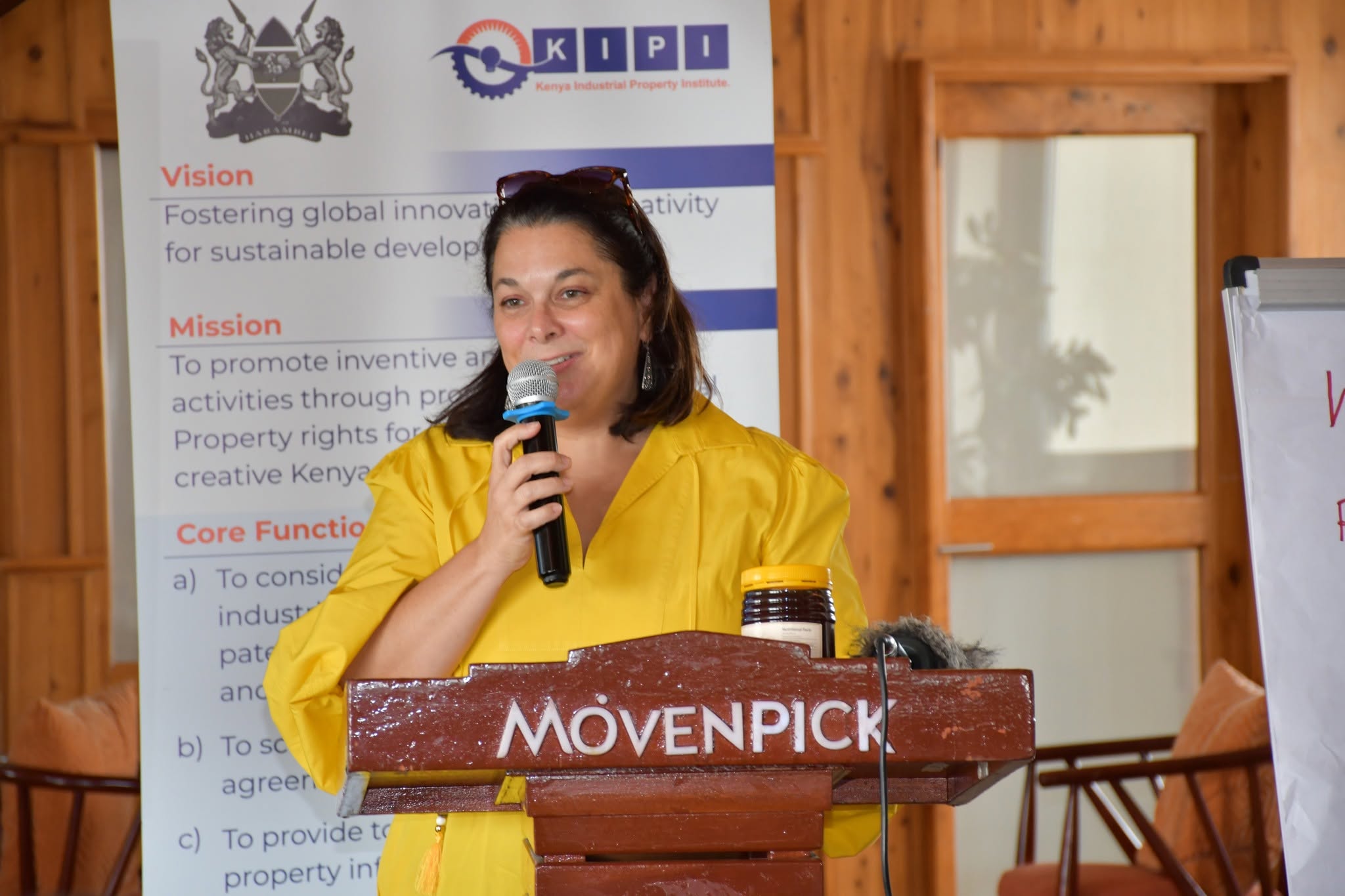
Institute, WIPO hosts High-Level Roundtable Workshop on Geographical Indications for stakeholders in Nairobi
Photo: Alexandra Grazioli speaking during the High-Level Roundtable Workshop on GIs in Nairobi
The Institute, in collaboration with World Intellectual Property Organization (WIPO), hosted a High-Level Roundtable Workshop on Geographical Indications (GIs) and the Lisbon System for stakeholders in Nairobi. The Lisbon System facilitates the International Registration of Appellations of Origin (AOs) and GIs, offering protection in 44 Contracting Parties, covering up to 73 countries, through a single registration procedure and one set of fees.
Alexandra Grazioli of WIPO noted that, to preserve the investments to develop GIs and their benefits in the current globalised economy and trade, there is a need for local communities to a have an accessible, convenient, effective and global tool to obtain protection worldwide.
“The solution is the WIPO Lisbon System, which is global, effective, simple and cost effective,” said Grazioli who is the Director, Lisbon Department for Trademarks, Industrial Designs and Geographical Indications, Brands and Designs Sector, at WIPO.
She said the Lisbon System is cost effective because it entails one application in one language and one set of fees for one to access protection in all Lisbon countries through a centralized management of GI portfolio. She noted that the System is effective because it provides high level protection, unlimited in time and hence requires no renewal fee, offering protection against genericness and covers all kinds of products.
John Onyango, the Institute’s Managing Director, said Kenya has a rich diversity of agricultural products, traditional products, cultural expressions and production practices that are associated with particular geographical locations and communities. “GIs provide Kenyans with an opportunity to protect the reputation, quality and identity of such products and, importantly, convert this uniqueness into economic value,” said Onyango in a speech read on his behalf by Stephen Ngeno, the Institute’s Deputy Managing Director, Technical Services.
The Workshop brought together lawyers, innovators, entrepreneurs, State Agencies, among others. Onyango said a well-functioning GI system can contribute to increased producer incomes, rural development, job creation, tourism, export promotion and preservation of cultural heritage.
"It can also enable Kenya to move beyond the export of raw commodities towards value-added, differentiated and premium products that are recognised in both local and international markets," he told the stakeholders. The Workshop, which was also attended by Mikael Linder of CIRAD, comes at a time when the country is in the middle of coming up with a law on GIs, the Geographical Indications Bill, 2026, which has just undergone the public participation process.